Lift, Firm, Refine: Your In-Depth Guide to Thermage® FLX at Peonia Medical.
Thermage® FLX is one of the core non-surgical lifting and tightening treatments offered at Peonia Medical. It is a fourth-generation monopolar radiofrequency device designed to heat the collagen-rich layers beneath the skin while protecting the surface. The aim is to improve skin laxity, soften fine lines and support facial contours, using a single treatment session with minimal interruption to daily life.
Peonia Medical was among the first ten officially recognised clinics in the UK to introduce the latest-generation Thermage FLX system. Over years of practice we have treated a wide range of patients – including different ages, facial structures and skin types – and have refined our approach to patient selection, energy settings and aftercare based on real clinical experience.
This article explains, in practical detail:
- What Thermage FLX is and how it differs from ordinary “skin tightening”
- How the technology works inside the skin
- Which concerns it can help with – and where its limits lie
- Why some people see excellent results and others do not
- Risks, side-effects and contraindications
- How we perform Thermage FLX at Peonia Medical and how we integrate it into long-term treatment plans
- The truth behind the common “roast chicken” or “over-cooked skin” myth
The aim is to give you a precise, realistic understanding of the treatment so you can make an informed decision alongside a medical professional.
1. What Exactly Is Thermage® FLX?
Thermage FLX is a non-invasive monopolar radiofrequency (RF) system. It is designed to deliver controlled heat into the dermis and subcutaneous tissues whilst actively cooling the epidermis. The intended clinical effects are:
- Immediate tightening of existing collagen fibres
- Medium to long-term stimulation of new collagen and elastin production
- Gradual improvement in skin firmness and fine lines
- Subtle enhancement of facial and neck contours
It is NOT:
- A laser or ultrasound device
- A surgical facelift
- A filler or volumising treatment
- A device that can permanently stop the ageing process
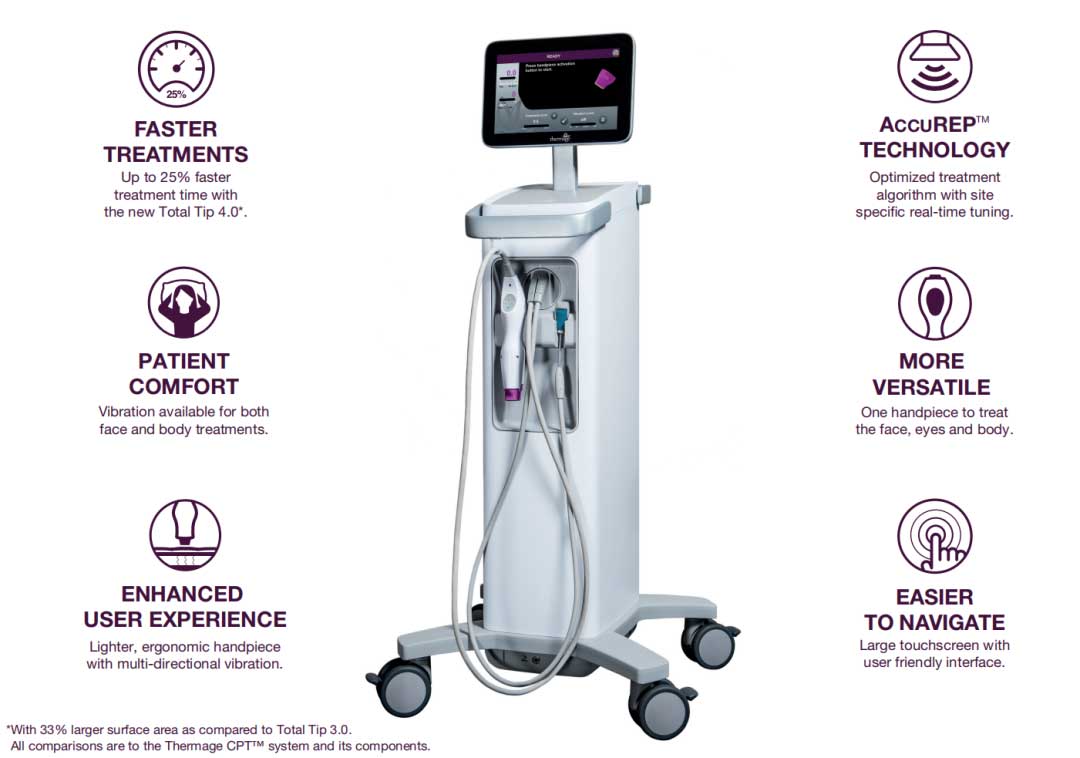
What sets Thermage FLX apart from many “radiofrequency facials” or beauty-salon devices is the combination of:
- Monopolar, deep-penetrating RF (able to reach several millimetres into the tissue)
- Real-time impedance-based energy control (AccuREP™ technology)
- Dynamic epidermal cooling (ThermaCool™ system)
- Standardised grid-based mapping for even, symmetrical coverage
- A long track record of medical use and published clinical data
Because of this, Thermage FLX is usually positioned as a medical-grade skin tightening option, performed by trained doctors or medical practitioners rather than as a beauty treatment.
2. How Ageing Affects Collagen – and Why RF Tightening Targets It
To understand how Thermage works, it is useful to know how collagen behaves.
The dermis is the deeper layer of the skin that contains a network of collagen and elastin fibres embedded in a gel-like ground substance (including hyaluronic acid).
In youth, collagen fibres are well-organised and densely packed, forming a strong “scaffold” that keeps the skin firm and elastic.
With age, chronic sun exposure, pollution, stress and hormonal changes, collagen becomes fragmented, thinner and more disorganised. Elastin also degenerates.
At the same time, the cells that produce collagen – fibroblasts – become less active. The balance shifts towards more breakdown and less production.
Clinically this appears as:
- Loss of definition along the jawline
- Early jowls
- Fine lines around the eyes and mouth
- Crepiness or “loose” texture on the lower face and neck
Thermage FLX aims to deliver heat into the collagen-rich layers at a temperature high enough to cause controlled, reversible “thermal injury”. This does two things:
Tightens existing collagen fibres in the short term.
Triggers a wound-healing cascade that stimulates fibroblasts to synthesise fresh collagen, elastin and ground substance over time.
3. Two-Stage Action: Immediate Tightening and Long-Term Remodelling
Thermage FLX works in two overlapping phases.
3.1 Immediate Tightening – Collagen Contraction
The monopolar RF energy passes through the skin and concentrates in the dermis and subcutaneous fibrous septae. When tissue temperature in these layers reaches roughly 55–65°C, hydrogen bonds within the triple-helix structure of collagen begin to break. This causes partial denaturation and contraction of the fibres.
A simplified analogy is lightly ironing a creased piece of fabric: the heat does not destroy the material, but it tightens and smooths it. In the skin this can translate to:
- A subtle feeling of tightness
- Slight lifting of the brows or jawline
- Minor reduction in fine lines
This first phase explains why some patients report that their face feels “supported” or “more compact” shortly after treatment, even though photographs may show only a modest early change.
3.2 Medium- and Long-Term Collagen Remodelling
The more important phase takes place over weeks to months. The micro-injury created in the dermis is interpreted by the body as a signal to repair. The key steps are:
- Recruitment and activation of fibroblasts into the heated area.
- Increased synthesis of type I and III collagen, elastin and hyaluronic acid precursors.
- Remodelling of the collagen matrix: new fibres are laid down and gradually replace part of the older, fragmented collagen.
- Thickening and re-organisation of the dermal layer, providing improved mechanical support to the overlying epidermis.
Clinical and histological studies of radiofrequency tightening show a characteristic timeline:
- 0–1 week: mainly acute collagen contraction and transient inflammation. Little true neocollagenesis yet.
- 2–4 weeks: fibroblast proliferation and increased production of collagen precursors; early thickening of the dermis.
- 1–3 months: maturation and cross-linking of new collagen; measurable reductions in wrinkle depth and improved skin firmness in many patients.
- 3–6 months: ongoing collagen remodelling; results tend to plateau and stabilise.
This is why, in our practice, we usually schedule major review photographs at 3 and 6 months, not only at one or two weeks. The treatment is designed to work gradually, not as an instant “overnight facelift”.
4. How Thermage FLX Delivers Heat Safely and Evenly
The main engineering challenge with any RF device is how to heat the deeper tissues sufficiently without burning or damaging the superficial epidermis. Thermage FLX addresses this in several ways.
4.1 ThermaCool™ Dynamic Cooling
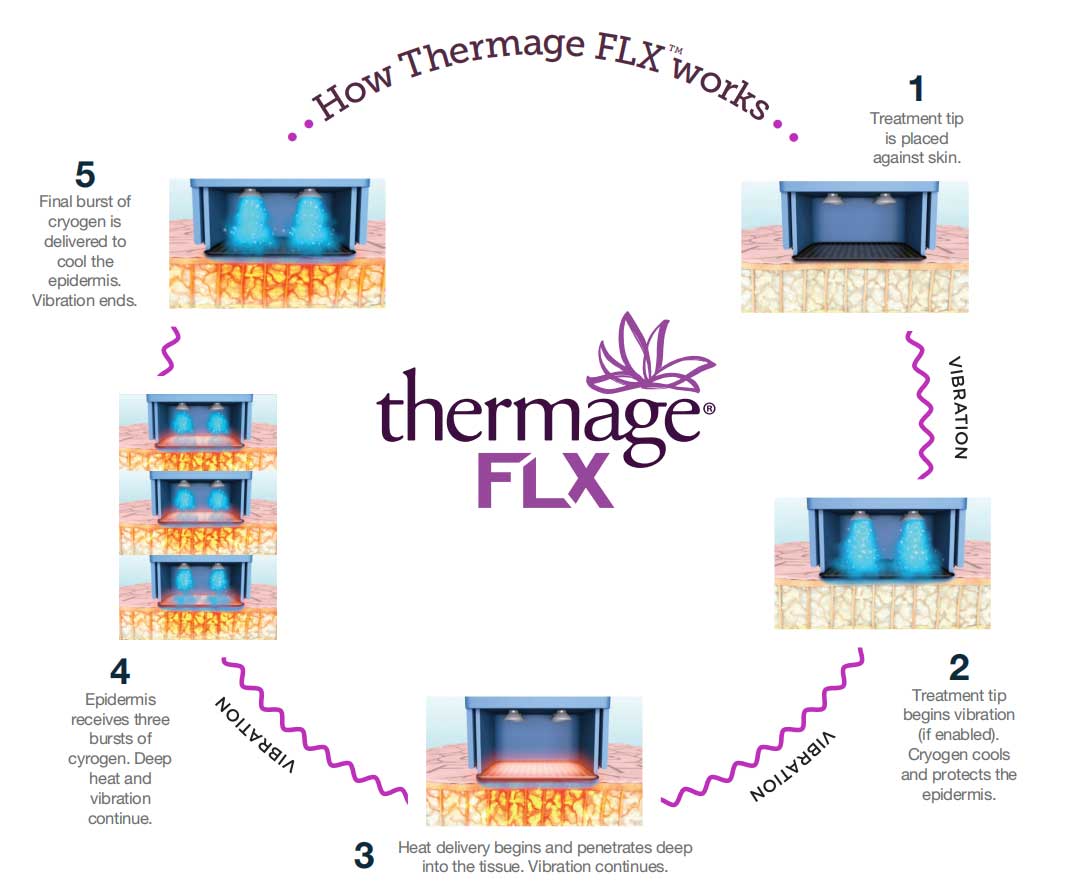
Each pulse of Thermage FLX consists of a sequence:
- Initial cooling burst: a cryogen spray cools the epidermis.
- RF energy delivery: the deeper layers are heated to the target temperature.
- Final cooling burst: the surface is cooled again.
This produces a “reverse thermal gradient” – the deeper dermis becomes warmer than the epidermis, which reduces the risk of surface burns or blisters.
Clinical data from large patient series show that, with appropriate technique and functioning cooling, the rate of true epidermal burns is low. Most patients experience only transient redness and warmth that settle within hours to a few days.
4.2 AccuREP™ Impedance-Based Energy Control
Human skin does not have a uniform electrical resistance. For example:
The thin, delicate tissue around the eyes typically has a higher impedance.
The thicker, more sebaceous skin on the cheeks has a lower impedance.
If the device delivered the same fixed energy everywhere, areas with lower impedance could receive excessive heating, causing pain or burns, while areas with higher impedance might be under-treated.
To mitigate this, Thermage FLX continuously measures the impedance of each treated spot and automatically adjusts the voltage and current of the RF pulse. The aim is to keep the thermal effect in the target layer consistent across different areas of the face and body.
From a practical point of view this means:
- More comfortable treatment, as “hot spots” are reduced.
- More predictable clinical outcomes across zones with different tissue characteristics.
- Less reliance on guesswork and more reliance on real-time feedback from the device.
4.3 Grid-Based Mapping and Standardised Coverage
Before treatment, a single-use adhesive grid is usually applied to the skin. Each small square corresponds to a defined treatment area.
This approach helps to:
- Provide symmetry: for example, ensuring that both sides of the face receive similar coverage and number of pulses.
- Avoid excessive overlapping that could cause local overheating.
- Document exactly how many shots were delivered where, which is important for audit and for planning any future sessions.
At Peonia Medical we record:
- Treatment areas and tips used (standard, eye, body).
- Energy settings, number of passes and total pulses per region.
- Patient feedback during treatment (comfort, sensitivity in particular zones).
This data is stored in the medical record and helps us refine our protocols over time.
5. Indications: What Thermage FLX Can Help With
Thermage FLX is best suited to mild to moderate laxity where there is still a reasonable amount of collagen and structural support present. It is not a substitute for surgery in advanced cases.
Common treatment areas include:
- Upper face and brow
- Early brow descent
- Horizontal forehead lines linked to laxity
- Periorbital region (eye area)
- Mild to moderate hooding of the upper lids
- Fine lines and crepiness under the eyes
- Crow’s feet associated with skin laxity rather than dynamic movement alone
- (This uses a dedicated eye tip and requires careful screening.)
- Mid-face
- Softening of the cheek area
- Early deepening of the nasolabial folds
- Loss of support in the “malar” (cheekbone) area
- Lower face and jawline
- Early jowls
- Loss of definition along the jawline
- Submental and neck region
- Mild to moderate laxity under the chin
- Early horizontal neck lines and crepiness
Off-face areas such as abdomen, thighs or arms can also be treated with appropriate tips.
We routinely combine Thermage FLX with other modalities where appropriate. For example:
- Injectable neuromodulators for dynamic wrinkles
- Hyaluronic acid fillers or collagen stimulators for volume loss
- Skin-quality treatments (chemical peels, lasers, medical skincare) for pigmentation or texture issues
The goal is global facial rejuvenation, not relying on one device to solve every problem.
6. Who Is a Good Candidate – and Who May Not Benefit
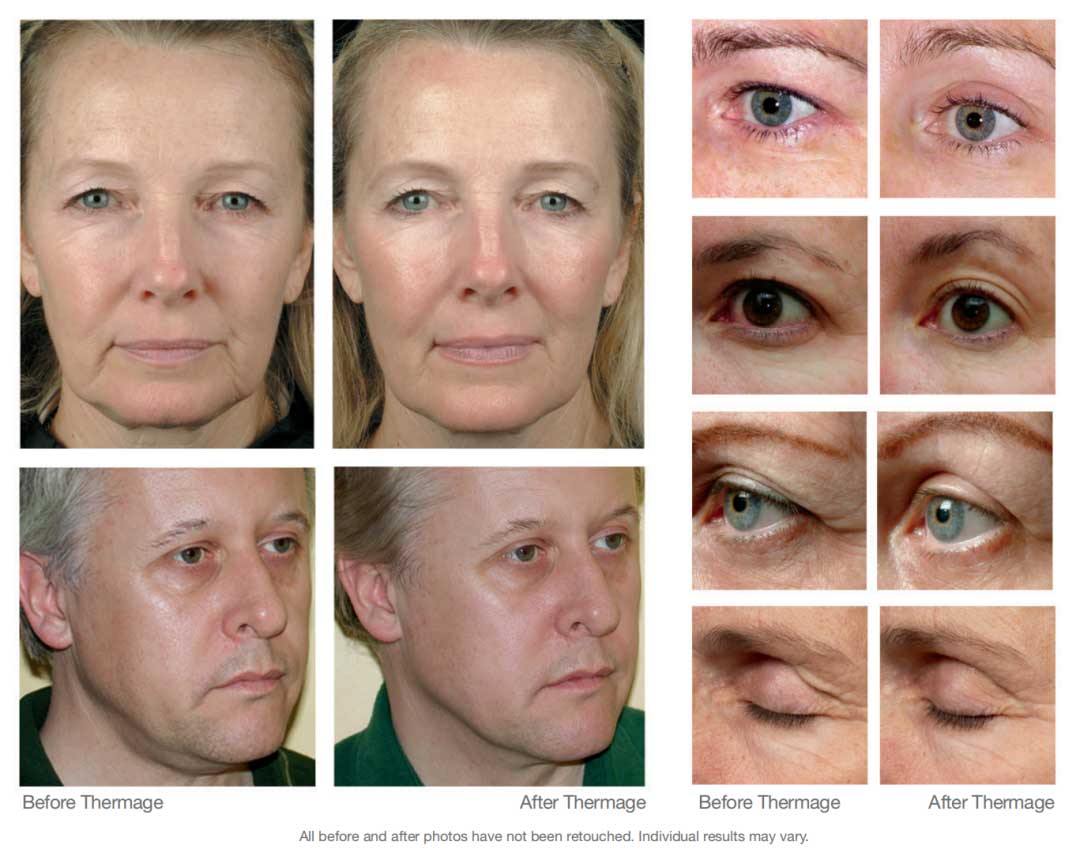
Based on our experience and the published evidence, Thermage FLX tends to work best when three conditions are met:
- There is visible but not extreme laxity – enough to see improvement, but not so advanced that surgery would be more appropriate.
- The patient has reasonable collagen reserves – typically non-smokers, with some degree of dermal thickness and not severely photo-damaged.
- Expectations are realistic – understanding that results are subtle and gradual, not dramatic or comparable to a facelift.
6.1 Situations Where Results May Be Limited
Clinical studies and our own cases suggest that approximately 10–15% of patients may see less improvement than expected. Common contributing factors include:
Low baseline collagen: older patients (for example mid-50s and above) with long-term sun damage, smoking history or significant weight loss may have very thinned skin. Fibroblasts have less “raw material” to work with.
Chronic inflammation: conditions such as rosacea or poorly controlled inflammatory skin disease may reduce fibroblast activity and collagen synthesis.
Compromised aftercare: lack of sun protection or resumption of aggressive skin habits (e.g. unprotected tanning) can shorten result longevity.
In such cases we discuss alternative or combined approaches, and occasionally may advise not to proceed with Thermage FLX at all if we feel the cost-benefit ratio is unfavourable.
6.2 Contraindications
Thermage FLX is generally avoided or deferred in the following situations:
- Pregnancy or breastfeeding
- Implanted electronic devices such as pacemakers or defibrillators
- Implanted metal materials such as bone fixations
- Active skin infection, open wounds or severe inflammatory dermatoses in the treatment area
- History of abnormal wound healing or keloid tendency in high-risk areas
- Unrealistic expectations or significant body dysmorphic concerns
A full medical consultation is required to screen for these factors.
7. Known Side-Effects and Risks
Like any effective energy-based treatment, Thermage FLX carries potential side-effects. In our practice we categorise them as expected, less common and rare.
7.1 Expected and Short-Lived Reactions
These are frequent, usually mild and self-limited:
- Redness and warmth in the treated area, ranging from a few hours to a day or two
- Mild swelling, especially under the eyes or around the jawline, settling over several days
- A feeling of “tightness” or sensitivity when touching the skin
Simple measures such as cool compresses and gentle skincare are usually sufficient to settle the short-term reactions..
7.2 Less Common Reactions
These are less frequent and typically manageable but should be discussed:
- Prolonged redness or localised swelling lasting more than a week
- Temporary areas of numbness or altered sensation
- Mild bruising in sensitive regions
- Short-term uneven texture or palpable firmness due to localised collagen response
We monitor patients closely and provide guidance if any of these arise.
7.3 Rare Complications
Rare but documented issues include:
- Superficial burns or blisters if cooling is inadequate or energy is mis-applied
- Post-inflammatory hyperpigmentation, more common in darker Fitzpatrick skin types, particularly if sun protection is neglected afterwards
- Contour irregularities or nodular firmness from excessive energy or overlapping in a small area
The risk of these events is significantly higher with unregulated devices, counterfeit treatment tips or inexperienced operators. At Peonia Medical we only use genuine Solta Medical Thermage FLX equipment and adhere strictly to safety protocols to keep complication rates very low.
8. The Treatment Process at Peonia Medical
Our approach to Thermage FLX is structured, doctor-led and data-driven.
8.1 Consultation and Assessment
Every patient undergoes a detailed consultation with a doctor experienced in aesthetic medicine. This includes:
- Comprehensive medical history and medication review
- Skin type, thickness and laxity assessment
- Examination of facial fat distribution and bone structure
- Photography for baseline documentation
- Discussion of concerns, priorities and lifestyle factors
At this stage we decide jointly whether Thermage FLX is appropriate, whether it should be combined with other treatments, or whether another option would be more suitable. We also outline:
- Expected degree of improvement (for example “mild softening of jowls”, not “ten-year facelift”)
- Possible risks and downtime
- Alternative approaches, including doing nothing
If either the patient or clinician is not comfortable, we do not proceed.
8.2 Preparation and Mapping
On the day of treatment:
- The skin is thoroughly cleansed and any make-up removed.
- Jewellery is taken off and grounding pad placed if required by protocol.
- An adhesive electrode return pad is applied to the skin on the back.
- A ink-transferrable treatment grid is applied to the area.
- Optional oral analgesia may be provided beforehand.
- A coupling gel is applied to enhance energy transfer and comfort.
8.3 Energy Delivery
The doctor then:
- Selects the appropriate tip (face, eye, body) and initial energy range, based on skin thickness and patient profile.
- Works systematically across each grid square, delivering the planned number of pulses per region while adjusting settings according to patient feedback and skin response.
- Monitors the device readings (including impedance) and the clinical endpoint (erythema, patient tolerance).
- Patients typically feel a series of short bursts of heat accompanied by vibration and cooling. The intensity can be adjusted; we aim for a level that is tolerable but effective.
Treatment duration varies:
Full face: approximately 60–90 minutes including preparation
Eyes only: shorter
Face and neck combined: longer
8.4 Immediate Post-Treatment
After treatment:
- The grid is removed and the skin is gently wiped.
- A soothing or hydrating product and high-SPF sunscreen are applied.
- The patient is reviewed for any focal hot spots or areas of concern.
- Written aftercare instructions are provided.
Most patients return to normal activities immediately. Make-up can usually be applied the next day if the skin is comfortable.
8.5 Follow-Up
We typically offer review appointments at:
- Around 6–8 weeks (early response and reassurance)
- Around 3–6 months (main photographic comparison and planning)
At these visits we evaluate:
- Degree of lift and tightening relative to baseline photographs
- Skin texture and fine lines
- Whether further interventions would be helpful or unnecessary
How Thermage FLX fits into the patient’s long-term maintenance plan
We do not routinely encourage very frequent repeat Thermage sessions. For most suitable patients, intervals of at least 12–18 months between full-face treatments are reasonable, and sometimes longer.
9. Longevity of Results and Treatment Frequency
No non-surgical procedure can permanently stop ageing. Thermage FLX aims to slow and partially reverse some of the structural changes in the treated area.
Broadly:
- Improvement usually builds over 3–6 months.
- Benefits may continue for one to several years, depending on lifestyle, genetics, sun exposure and other factors.
- The natural ageing process continues in untreated areas and in deeper tissues such as bone and fat.
We therefore position Thermage FLX as a “collagen management” procedure, not a once-in-a-lifetime cure. Many patients choose:
- An initial full-face or face-and-neck treatment
- Skincare, sun protection and other maintenance procedures in between
- A repeat Thermage session only when changes justify it, often in the 12–24 month range
- The decision is always individual and made with a doctor after reviewing photographs and expectations.
10. The “Roast Chicken” Myth – Does Repeated Thermage Damage the Skin?
A frequent concern, especially online, is that repeated energy-based tightening treatments will “cook” the skin, making it thin, dry and inelastic – the so-called “roast chicken” effect.
From a physiological perspective, this fear is understandable but oversimplified.
Collagen in the skin is continuously being broken down and rebuilt throughout life.
Ageing shifts the balance towards more breakdown and less synthesis.
Thermage FLX introduces a controlled, temporary thermal stimulus that nudges fibroblasts to produce more collagen for a period of time.
When correctly performed at intervals that respect the biological healing cycle, the skin is not repeatedly destroyed; rather, it is periodically stimulated to renew a portion of its collagen matrix.
However, problems can arise when:
- Non-genuine or poorly calibrated devices deliver unpredictable energy with inadequate cooling.
- Operators lack anatomical knowledge and apply excessive energy or too many passes in delicate zones.
- Treatments are performed too frequently without clinical justification, interrupting the normal remodelling cycle.
In these scenarios, there is potential for irreversible damage, including atrophy or scarring.
At Peonia Medical we mitigate this risk by:
- Using only authentic Thermage FLX hardware and single-use tips.
- Ensuring all procedures are carried out by doctors with a strong background in dermatology or aesthetic medicine.
- Keeping detailed records of settings and pulses to avoid over-treatment.
- Advising conservative intervals between sessions and only repeating when there is a clear indication.
In short, the technology itself is not inherently “skin-destroying”. The safety and outcome depend heavily on equipment quality, protocol design and clinical judgement.
11. Why Choose Peonia Medical for Thermage FLX?
Several factors characterise our Thermage practice.
11.1 Early Adoption and Large Case Experience
Peonia Medical was among the first ten officially recognised clinics in the UK to offer Thermage FLX.
Over the years, we have treated a broad spectrum of patients, including British and international clients with diverse skin types and ageing patterns.
This has allowed us to refine protocols beyond generic manufacturer guidelines, within safe boundaries.
11.2 Doctor-Led, Evidence-Informed Practice
All Thermage FLX consultations and treatments are performed by medical doctors.
We integrate knowledge from dermatology, facial anatomy and aesthetic surgery when planning treatments.
We are transparent about limitations and do not hesitate to suggest alternatives or decline treatment when appropriate.
11.3 Emphasis on Safety and Natural Outcomes
Our treatment philosophy can be summarised as:
- Authentic devices only – no copy machines, no re-used tips.
- Conservative but effective parameters, prioritising tissue health over extreme short-term change.
- Combination planning – using Thermage FLX alongside, not instead of, other proven therapies when this gives a better overall result.
- Long-term follow-up, so we can see how skin responds over years rather than weeks.
11.4 Individualised Decision-Making
We do not regard Thermage FLX as a compulsory step for everyone interested in anti-ageing. For some, skincare, injectables or lifestyle changes may be more appropriate; for others, surgical options might eventually offer better value.
Our role is to:
- Explain where Thermage FLX sits among the available options
- Evaluate whether it is suitable for your specific skin and goals
- Offer it when it genuinely fits into a sensible, staged treatment plan
12. Summary
Thermage® FLX is a medically engineered monopolar radiofrequency system designed to tighten and remodel the skin’s collagen framework without surgery. It acts in two phases:
Immediate collagen contraction, giving a subtle early tightening.
Gradual collagen regeneration, improving firmness and fine lines over 3–6 months or more.
Its safety and effectiveness depend on:
- Accurate delivery of heat to the deeper tissues
- Protection of the epidermis through dynamic cooling
- Real-time adjustment of energy according to skin impedance
- Standardised, symmetrical coverage using grid-based mapping
- Careful patient selection, realistic expectations and proper aftercare
Thermage FLX is not suitable for everyone, and results vary with age, skin type, lifestyle and biological response. It is one tool within a wider anti-ageing strategy, not a replacement for all other modalities or for surgery where that is clearly indicated.
At Peonia Medical we have many years of experience with Thermage FLX and was one of the earliest UK adopters of this latest-generation system. Our doctor-led team focuses on:
- Honest assessment of who is likely – and unlikely – to benefit
- Safe and precise delivery using genuine equipment
- Integration of Thermage FLX into comprehensive, long-term skin health plans
If you are considering non-surgical tightening, a face-to-face medical consultation remains the essential first step. During that visit we can assess your individual situation, show real case examples and discuss whether Thermage FLX, another treatment, or simple observation is the most appropriate choice for you.