
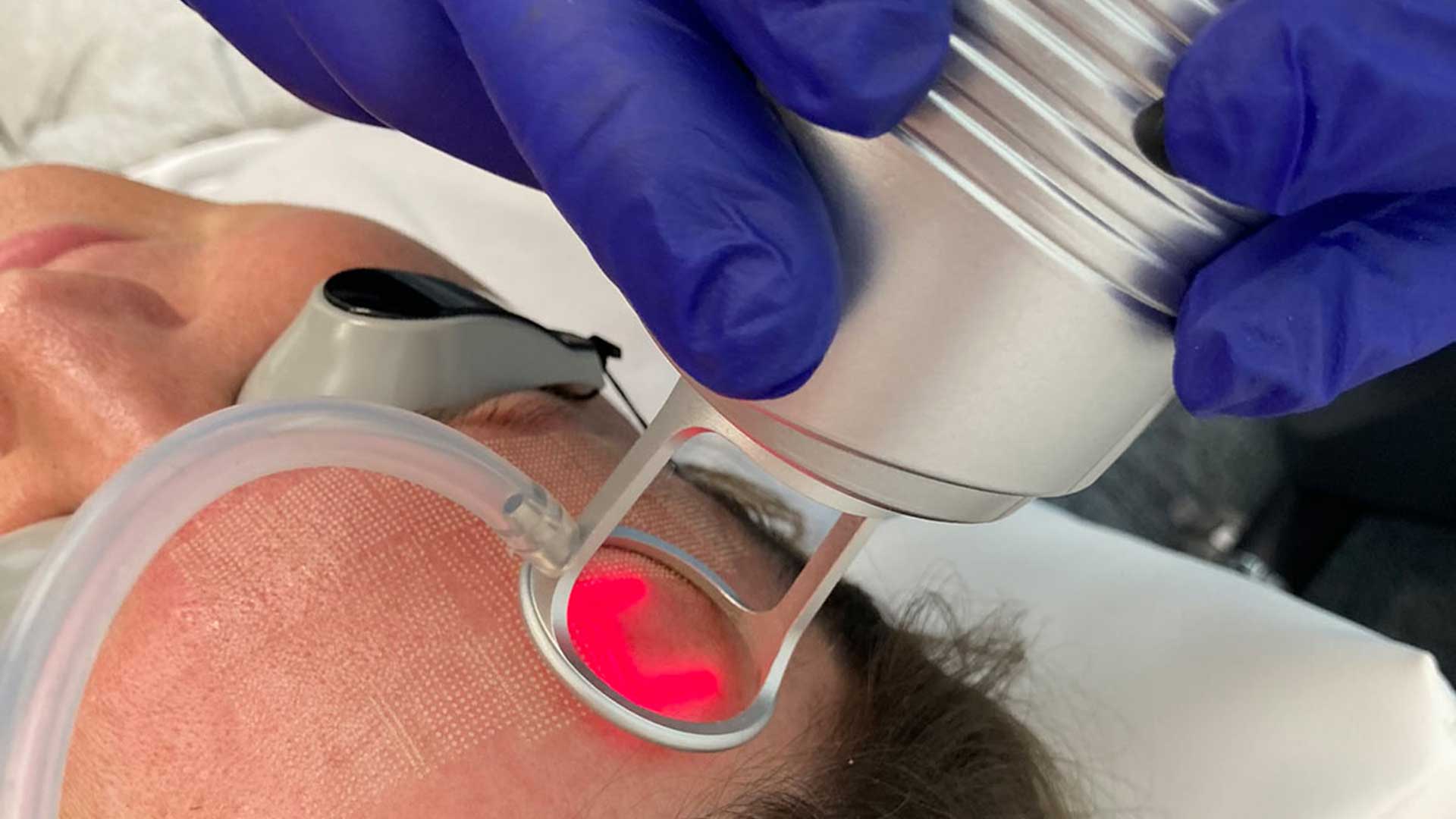
CO2 Laser Skin Tightening vs Blepharoplasty:
When Is Eyelid Surgery the Better Choice?
Understanding the difference between improving skin quality and removing excess skin — and how to choose the right treatment for ageing eyes.
The delicate skin around our eyes is often one of the first areas to show signs of ageing. Fine lines become more noticeable, the skin gradually loses its firmness, and the upper eyelids may begin to look heavier or more hooded.
For many patients, this raises an important question:
Can CO2 laser skin tightening improve loose eyelid skin, or is blepharoplasty (eyelid surgery) a more appropriate solution?
The answer depends on what is actually causing the changes around your eyes.
At Peonia Medical, we believe that successful facial rejuvenation starts with understanding the underlying anatomy rather than simply choosing the most popular treatment.
1. Why does the skin around our eyes age differently?
The skin around the eyes is particularly thin and delicate. As we age, several changes can occur simultaneously:
- Collagen and elastin gradually decline, contributing to fine lines and reduced skin elasticity.
- Sun exposure and environmental damage affect skin texture and firmness.
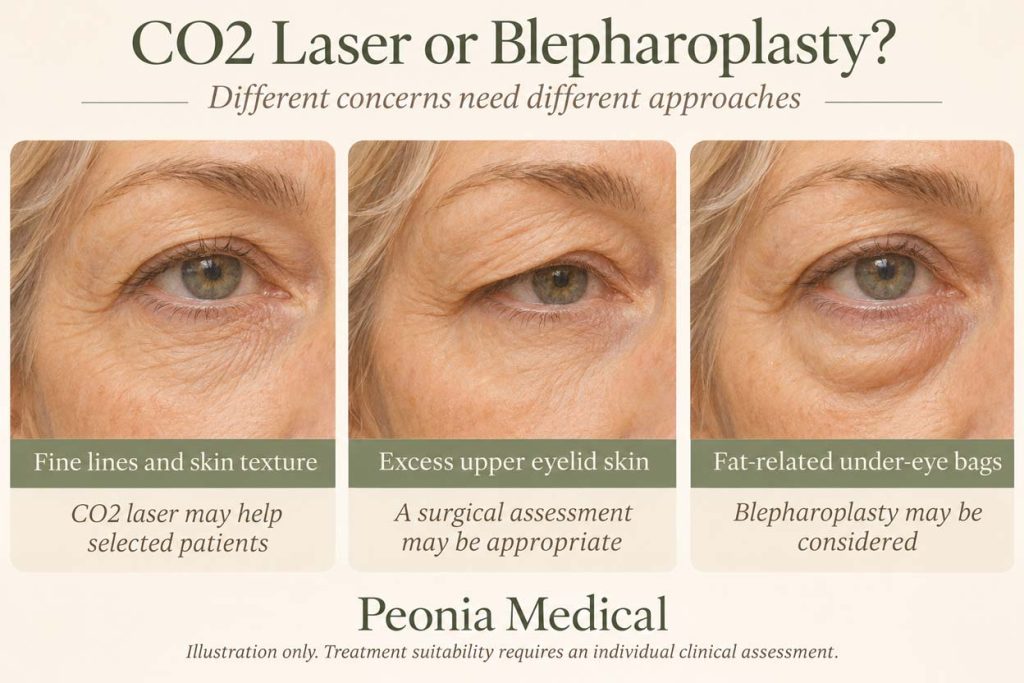
- Excess upper eyelid skin may accumulate, creating a hooded appearance.
- Changes in the supporting tissues around the eyes can allow orbital fat to protrude, producing under-eye bags.
- Eyebrow descent can make the upper eyelids appear heavier, even when the eyelid skin itself is not significantly excessive.
These changes may look similar in the mirror, but they require different approaches to treatment.
2. What is CO2 laser skin tightening, and how does it work?
CO2 laser resurfacing is an established treatment used to improve skin texture, fine lines, wrinkles and certain types of scarring.
It uses a wavelength of 10,600 nm, which is strongly absorbed by water within the skin.
During fractional CO2 laser treatment, controlled columns of laser energy create microscopic treatment zones while leaving areas of surrounding skin intact. This initiates a wound-healing response and stimulates collagen remodelling.
Over the following weeks and months, the skin may become smoother and firmer as it heals and remodels.
For appropriately selected patients, CO2 laser resurfacing can help improve:
- Fine lines and crepey skin around the eyes
- Mild skin laxity
- Uneven skin texture
- Certain superficial wrinkles and signs of sun damage
However, CO2 laser treatment cannot reliably remove substantial excess eyelid skin or correct prominent protruding fat pads.
3. When should you consider CO2 laser treatment?
CO2 laser skin tightening may be worth considering when your main concern is the quality of your skin rather than the amount of excess skin.
For example, you may notice fine wrinkles beneath your eyes when smiling, a slightly crepey texture or mild looseness without significant folds of redundant skin.
In these circumstances, improving collagen structure and skin texture may provide a worthwhile aesthetic improvement without surgical skin removal.
However, CO2 laser resurfacing is not a lunchtime facial. As an ablative treatment, it causes controlled skin injury and requires an appropriate recovery period.
Redness, swelling, crusting and temporary changes in pigmentation may occur. More significant complications, including infection, scarring, persistent pigmentary changes and eyelid malposition, are possible.
Patients with darker skin tones may have a greater risk of post-inflammatory hyperpigmentation, making careful assessment and treatment selection particularly important.
Laser treatment close to the eyes also requires specialist training and appropriate ocular protection.
4. When is blepharoplasty the better option?
Blepharoplasty is a surgical procedure designed to address structural changes in the eyelids.
Unlike CO2 laser resurfacing, which primarily improves skin quality, blepharoplasty can physically remove redundant skin and, where appropriate, reposition or remove protruding fat.
Upper blepharoplasty: addressing hooded eyelids
Upper eyelid surgery may be more appropriate when:
- Excess skin hangs over the natural eyelid crease.
- The upper eyelids feel heavy or appear persistently hooded.
- Loose skin rests close to or over the eyelashes.
- Significant skin redundancy cannot reasonably be corrected by tightening alone.
- Excess skin interferes with the upper or peripheral visual field.
An upper blepharoplasty generally involves an incision positioned within the natural eyelid crease, allowing carefully planned removal of excess tissue.
However, not every hooded eyelid requires blepharoplasty. Sometimes, a low eyebrow position or true eyelid ptosis is the primary cause. These conditions may require a different surgical approach.
Lower blepharoplasty: addressing eye bags
Lower eyelid surgery may be more suitable when the main concern is prominent eye bags caused by protruding orbital fat.
Depending on the anatomy, surgery may involve repositioning fat, removing selected excess tissue or improving lower eyelid support.
Importantly, not all under-eye concerns are caused by fat protrusion. Hollow tear troughs, pigmentation, fluid retention and skin laxity can create similar appearances.
A thorough examination is therefore essential before considering surgery.
5. CO2 laser vs blepharoplasty: what are the key differences?
| Consideration | CO2 laser resurfacing | Blepharoplasty |
| Main purpose | Improve skin quality and mild laxity | Correct excess skin and selected structural problems |
| Fine lines | Often beneficial | May remain after surgery |
| Significant loose skin | Limited improvement | Can remove excess skin |
| Prominent fat-related eye bags | Does not correct the fat protrusion | Can address protruding fat |
| Recovery | Usually days to weeks, depending on intensity | Allow around 2 weeks off work; bruising and swelling may last longer |
| Main considerations | Pigment changes, infection, scarring, eye safety | Scarring, asymmetry, dry eyes, eyelid position and surgical risks |
Neither treatment is universally better. They address different problems, and results vary between patients.
6. Can CO2 laser and blepharoplasty work together?
Yes. In carefully selected patients, CO2 laser resurfacing can complement blepharoplasty by improving fine lines and skin texture and providing additional skin tightening. Surgery addresses excess tissue and eyelid contour, while resurfacing treats the skin itself.
CO2 laser may be planned before surgery, after surgery, or on the day of surgery during the same treatment session. These are alternative approaches to timing; patients do not routinely need laser treatment at all three stages.
Before surgery, laser may be considered as part of a staged plan to address skin quality. The skin must be allowed to heal, and the surgeon should reassess the tissues before proceeding with blepharoplasty. Laser does not replace removal of substantial excess skin.
After surgery, laser may be considered for remaining fine lines, crepey texture or mild laxity once healing is sufficient and the surgeon considers treatment appropriate.
On the day of surgery, appropriately selected patients may have CO2 laser resurfacing alongside blepharoplasty to address skin texture and laxity within one planned treatment session. This can bring the recovery periods together, but combined treatment is not suitable for everyone.
The sequence, treatment area, laser settings and healing interval must be tailored to skin type, eyelid support, eye health and the planned surgery. Excessive tightening or scarring, particularly around the lower eyelid, can affect eyelid position and function. Specialist expertise and appropriate eye protection are essential.
7. Is it better to try CO2 laser before considering surgery?
Not necessarily.
It is understandable that many patients prefer to explore non-surgical treatments first. However, the least invasive treatment is not automatically the most appropriate.
If the primary problem is significant excess eyelid skin, repeated laser treatments may offer limited improvement while adding unnecessary cost, recovery time and cumulative risk.
On the other hand, surgery may be unnecessary when the main concern is mild skin laxity or fine wrinkles.
The most effective treatment plan is not always the one that involves the most procedures. It is the one that addresses the right problem with the least unnecessary intervention.
This is particularly important around the eyes, where both appearance and normal eyelid function must be preserved.
8. How do we assess eyelid ageing at Peonia Medical?
At Peonia Medical, our approach to eye rejuvenation begins with an individual clinical assessment.
Rather than recommending CO2 laser or eyelid surgery based solely on age or photographs, we consider the underlying causes of each patient’s concerns.
This includes examining skin quality, the degree of excess skin, eyelid position, eyebrow position, fat distribution and relevant eye health considerations.
We also discuss the expected benefits, limitations, recovery and potential risks of each treatment.
For some patients, CO2 laser resurfacing may be an appropriate starting point. Others may benefit more from a surgical assessment for upper or lower blepharoplasty. And sometimes, no intervention is necessary.
Our aim is to achieve results that look natural, healthy and balanced, while respecting the anatomy and function of the eyes.
9. Frequently asked questions
Can CO2 laser replace upper eyelid surgery?
For mild skin laxity and fine wrinkles, CO2 laser may offer improvement. However, it cannot reliably replace blepharoplasty when substantial excess skin needs to be removed.
Does CO2 laser help with under-eye bags?
It may improve associated fine wrinkles or mild skin looseness, but it does not remove protruding orbital fat. Prominent structural eye bags may require a different treatment approach.
How long does CO2 laser skin tightening last?
Improvements from collagen remodelling may persist for months or longer, but longevity varies with treatment settings, skin condition, sun exposure and the natural ageing process. Results are not permanent.
Will blepharoplasty remove all wrinkles around my eyes?
No. Blepharoplasty primarily addresses excess tissue and eyelid contour. Fine lines, crow’s feet and skin texture may require separate assessment and treatment.
Which treatment is safer?
Both treatments carry risks, and neither is inherently safer for every patient. Safety depends on patient selection, medical history, anatomy, treatment technique and appropriate aftercare.
10. Final thoughts: treat the cause, not just the appearance
Ageing around the eyes is rarely caused by one single factor.
Fine lines, reduced elasticity, excess skin, protruding fat and changes in eyebrow position can all contribute to a tired or heavy appearance.
Understanding which structures are responsible is the first step towards choosing an appropriate treatment.
At Peonia Medical, we believe that good aesthetic medicine is about making thoughtful, informed decisions — not simply doing more.
Natural · Healthy · Balanced.
Considering CO2 laser skin tightening or blepharoplasty?
If you are concerned about loose eyelid skin, fine lines or under-eye bags, our medical team can help you understand the available treatment options and whether intervention is appropriate.
All treatments are subject to individual medical assessment. Outcomes vary, and no procedure is without risk.